

We all know that little moment of stress in front of the airport scales, just before printing our luggage tag. But in 2026, the game has changed: it's no longer just a question of cabin baggage dimensions , it has become a real battle against weight.
Since airlines quietly reduced cabin weight limits from 1 to 2 kg, many travelers find themselves trapped at the boarding gate, forced to pay hefty surcharges even though their bag appears compact.
This is where Compactor compression technology comes in, but be warned: while removing the air from your clothes is the best suitcase packing tip, it 's not always the best. Gaining 50% more space does not mean you'll lose any excess weight from your luggage.
Let's stop haphazardly stuffing our suitcases and start traveling smarter. The idea is to completely change the way you pack so it's truly suited to 2026. We're not just going to talk about folding clothes: I'm going to show you how to manage weight once your suitcase is compressed and how to intelligently organize the transfer to your small 40 x 30 x 15 cm carry-on bag. Honestly, this is the only real trick that will allow you to stop stressing in front of the scales at the airport and finally travel with peace of mind.
Why has suitcase packing trick become vital with the 2026 standards?
By 2026, packing your suitcase properly is no longer just a convenience for organization fanatics: it's your only line of defense against airlines' new "lightweight" fare policies. With a general reduction in baggage allowances from 1 to 2 kg and the arrival of ultra-sensitive 3D scanners at boarding gates, poorly packed luggage now exposes you to immediate fees often exceeding €75. The reality on the ground is simple: if you don't control the density of your luggage, you'll end up paying to carry air.
The trap of gate scales: when your cabin baggage is weighed just before the plane
You are not always told this when you buy your ticket, but since the beginning of 2026, weight checks have moved from the check-in counter to the boarding gate. This is the critical point where 30% of passengers get trapped. The problem? Compression allows you to pack more clothes, but the weight remains the same. If you don't practice "strategic transfer" (moving heavy items like chargers or books into your small 40 x 30 x 15 cm personal bag), your suitcase will exceed the new 7 or 8 kg limits imposed by airlines like Lufthansa or Emirates.
Table: Comparison of weight/volume tolerances (2024 vs 2026)
|
Setting |
2024 Standard (Average) |
2026 Standard (Average) |
Traveler Impact |
|
Maximum cabin weight |
10-12 kg |
7-8 kg |
- 2 kg margin |
|
Small free bag |
40 x 20 x 25 cm |
40 x 30 x 15 cm |
Flatter format |
|
Weight control |
Random at the counter |
Systematic at the door |
Guaranteed surcharge |
3D scanners and irregular shapes: why a "smooth" storage arrangement facilitates inspections
Technology has also changed the game in security lines. Next-generation 3D scanners don't like disorder. A bag with loose contents creates areas of uneven density and blind spots for imaging. According to the latest TSA guidelines, irregularly shaped luggage has a 22% greater chance of undergoing a full manual inspection.
The pro suitcase packing tip for 2026 is to use vacuum bags to create "geometric blocks." By compressing your clothes into neat rectangles, you ensure a smooth reading for the washing machines. Not only do you avoid having your suitcase unpacked in front of everyone, but you also ensure that your bag won't be rejected by the cabin because of a centimeter of "bulge" that doesn't fit through the metal sizer.
The secret of "phantom volume": the suitcase packing trick to double your capacity
Let's be clear: the best suitcase packing tip in 2026 isn't about folding your t-shirts tighter, but about declaring war on air. Textile science tells us that your clothes are made up of 50% to 80% empty space trapped between the fibers. By eliminating this "phantom volume," you don't just save a little space: you cut your wardrobe in half, allowing you to pack 10 days' worth of clothes in a carry-on size without straining the zipper.
Vacuum bags vs. packing cubes: which solution for which trip?
This is the big debate among travelers this year. To choose the right suitcase packing solution , you must first identify your priority. Packing cubes are excellent organizational tools (one cube for tall items, one for shorts), but they don't physically reduce volume. Conversely, Compactor vacuum bags work by reducing pure density.
For a business trip with delicate shirts, packing cubes protect against chafing. But for a winter getaway or a city break with just a backpack, vacuum technology is the only way to dramatically reduce space in your carry-on .
Roll-up technology: compress without a vacuum cleaner while traveling
The favorite packing trick for road trip enthusiasts in 2026 is undoubtedly the roll-up bag . Why? Because when traveling, you don't always have a vacuum cleaner handy when it's time to repack your bag for the next leg of your journey.
The operation is simple and intuitive: you place your clothes in the bag, close it with the zipper, and then roll it up to expel the air. Once compressed, the textiles are kept in an airtight environment. Made from durable materials like polyethylene and nylon, these bags effectively protect your clothes from moisture, dust, and odors throughout your trip. It's the perfect tool for keeping your suitcase organized, even after six hotel changes. To discover our models, browse our collection of travel storage accessories .
Managing the weight paradox: The suitcase packing trick to avoid paying excess baggage fees
In 2026, the fatal mistake is confusing "space saving" with "lightness." This is what's known as the density trap: by compressing your clothes with Compactor technology, you free up an incredible amount of space, which unconsciously leads you to fill the "empty spaces" with other items. As a result, your suitcase is compact, but it ends up weighing 12 kg instead of the 8 kg now allowed by most airlines. To avoid the baggage fee at the boarding gate, your best packing tip is to learn to manage the actual weight of your belongings, not just their visual bulk.
Post-compression weighing: why weighing your bag AFTER deflating it is crucial in 2026
The real suitcase packing trick that almost no one uses is the two-step weighing method. Don't just weigh your belongings loose on the bed before you start. Once you've used your vacuum bags and everything is perfectly zipped, your brain is literally tricked by the small size of the luggage: it looks light because it's compact.
By 2026, airlines like Lufthansa, Emirates, and Ryanair have widely implemented mobile weight checks with electronic scales directly in the queue. Weigh your suitcase once it's closed and compressed: this is the only time you'll see the true weight. If the needle goes past the limit, don't try to force your way through. It's the signal that it's time to activate your smart weight-saving plan to rebalance your luggage.
The shedding method: how to make the most of your small 40 x 30 x 15 cm bag
Since September 2025, the European standard has clarified the rules: you are entitled to a small free personal bag to be placed under the seat in front of you.
But be careful, to avoid choosing the wrong size and risking extra charges, double-check the cabin baggage dimensions specific to your airline before packing your bag. The pro packing tip is to use this small 40 x 30 x 15 cm bag as a true "emergency zone" for your bulkiest items.
As we've seen, agents now scrutinize the shape of all your luggage, including this small bag. However, the strictest weight limit (often 7 or 8 kg) primarily applies to your main carry-on suitcase.
Transfer your heavy but small items to this compartment: your laptop chargers, books, or external batteries (which, incidentally, will be strictly prohibited in checked baggage starting in 2026). By strategically moving these few items, you'll get back under the critical 8 kg weight limit for your main suitcase, while maintaining a neat, rectangular shape that will pass through 3D scanners without triggering any alerts.
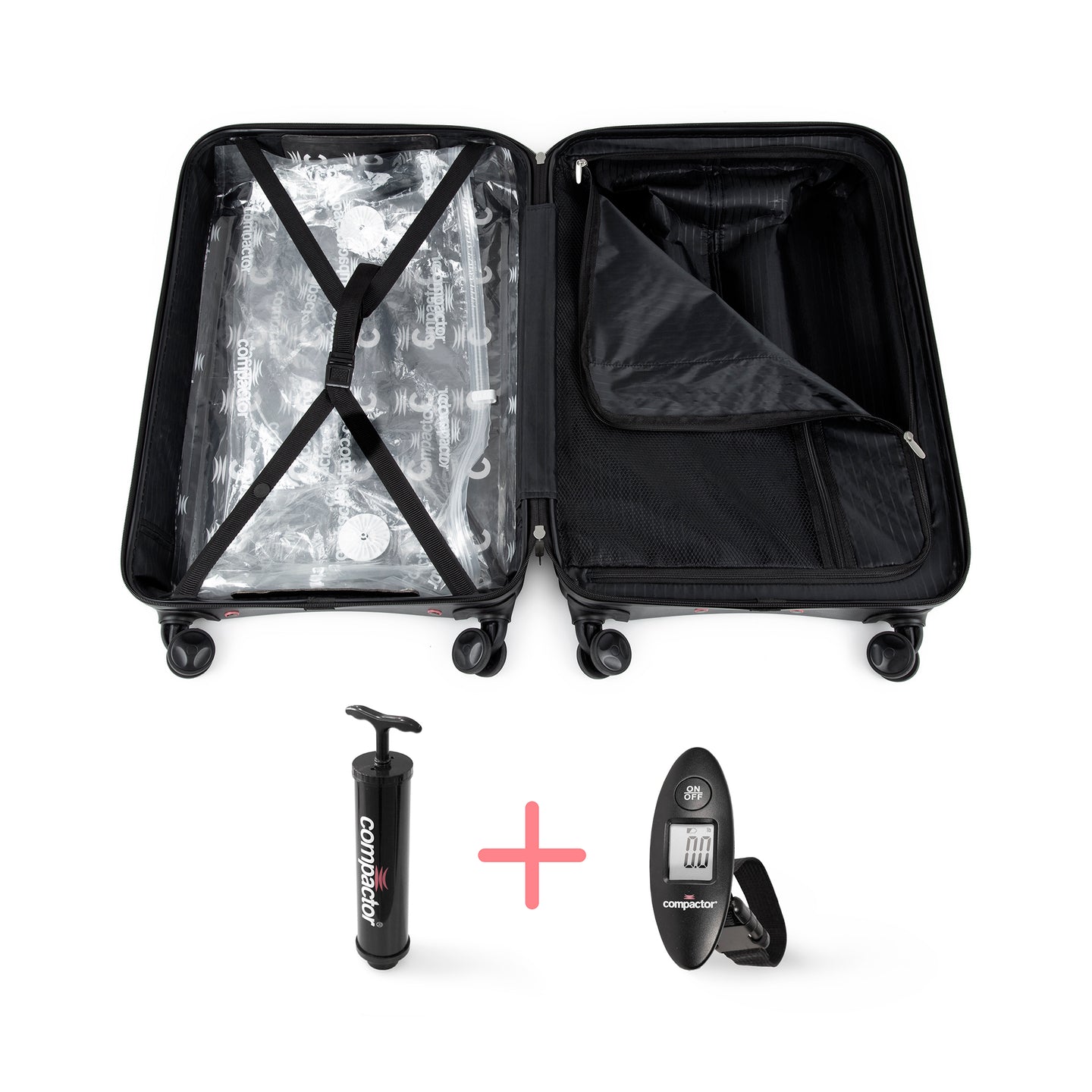
Model shown: Hybrid vacuum-sealed suitcase, size L
Suitcase packing tips for special cases (souvenirs, wedding, fragile items)
Traveling in 2026 isn't just about packing spare t-shirts. The real challenge of effective suitcase packing is knowing how to handle the exceptional: bringing back a handcrafted ceramic piece without it ending up in pieces, or transporting a formal outfit in the cabin without spending your honeymoon in front of an iron.
The key lies in repurposing your compression accessories to transform your clothes into veritable protective shields. By mastering these "cocooning" techniques, you optimize your space while ensuring the integrity of your most precious belongings.
To go even further, don't hesitate to discover the secrets to a perfect cabin suitcase: pro tips that detail how to secure every corner of your luggage.
Managing dirty laundry: the inverted compression bag technique
We often make the mistake of throwing dirty laundry loose at the bottom of our bag. As a result, it takes up twice as much space as clean clothes and contaminates the smell of the rest of the suitcase. The pro packing tip is to dedicate a Compactor Roll-up bag exclusively to dirty laundry. As your stay progresses, you will compress your worn clothes. Because the fabric used is softer, the force of manual compression allows you to gain valuable volume, mechanically freeing up space for your new purchases. This is called dynamic archiving: your "clean" compartment shrinks while your "memory zone" expands.
Transporting a wedding dress or suit: the expert "Z" fold
If you're traveling for a special event in 2026, don't count on airplane wardrobes, which are often overcrowded. The essential packing trick for formal attire is the "Z" fold inside a lightweight garment bag.
· The method: Fold the garment in three to distribute the tension and avoid sharp breaks in the fabric.
· The secret: Layer sheets of tissue paper between each garment to reduce static electricity. Upon arrival, hang the outfit immediately in the bathroom during a hot shower: the natural steam will effortlessly relax the fibers.
The "vacuum cocoon": protecting your fragile items without bubble wrap
Instead of burdening yourself with heavy protective gear, use the physics of a vacuum. To bring back a fragile item, place it in the center of a Compactor storage bag, surrounded by soft textiles such as sweaters. By creating a partial vacuum, compression secures the item within the fabric, creating a rigid "cocoon" that absorbs shocks. This is the safest suitcase packing trick to transform your wardrobe into high-performance packaging. Here you'll find our best suitcase packing solutions.
Table: Summary of protection methods by object type
|
Object type |
Main risk |
Expert Solution 2026 |
Recommended equipment |
|
Dirty laundry |
Odors & Volume |
Reverse compression |
Compactor Roll-up Bag |
|
Dress / Suit |
False creases, pronounced |
Z-fold + Silk |
Semi-rigid case |
|
Fragile memories |
Breakage / Impacts |
Textile vacuum cocoon |
Manual vacuum bag |
|
Small bottles |
Leaks / Crushing |
Shoe safe |
Your spare sneakers |
Suitcase packing tips and maintenance for arrival at your destination
Once you arrive at your destination, the most effective packing tip isn't to frantically unpack everything, but to let your clothes breathe. After several hours in a vacuum, the textile fibers need to reabsorb air to regain their original structure. Polymer science tells us that the longer the textile remains compressed, the longer the recovery time. Let's be pragmatic: if you're wearing a linen blazer after a 12-hour flight, it's going to need a little help to look impeccable at your dinner.
Shower steam: for a flawless look without an iron
This is the little secret of frequent travelers in 2026 to counter the effects of emptiness. Upon arrival, hang your compressed clothes (especially cotton shirts, dresses, and pants) on hangers in the bathroom. Then take your shower: the hot steam will saturate the air and penetrate deep into the fibers, naturally relaxing them in less than 10 minutes.
This This suitcase packing tip is particularly recommended for natural materials such as wool or silk, which do not withstand the direct heat of a hotel iron that is often poorly maintained. For down jackets, shake them vigorously: they will regain their "loft" (inflation power) much more quickly by capturing ambient air.
Maintenance and longevity: How to make your Compactor bags last for several years
To ensure your suitcase packing tips remain effective in the long run, your accessories require a minimum of regular care. After each trip, it's essential to completely empty your bags and wipe the inside with a dry cloth. This eliminates any trace of residual moisture that could promote unpleasant odors during the next storage. Be vigilant: a single grain of sand stuck in the double zip or micro-valve can compromise the seal on your next trip.
Also remember to check the condition of the closing slider before each use to ensure that the vacuum will hold for the entire duration of the flight. Avoid using your travel bags for permanent storage exceeding 6 months without airing your clothes, in order to preserve the shape memory of the most fragile fibers. Finally, between trips, store your bags flat and out of the sun: this is the secret to ensuring their effectiveness for the next ten years.
By choosing our travel storage kits and treating them as textile engineering tools, you maximize your investment while reducing your plastic footprint.
FAQ: Secrets of the Lightweight Travel Experts
1. If I compress my clothes, won't my suitcase be too heavy?
This is the classic "density trap" of 2026. Yes, the " vacuum packing" trick lets you double your clothing volume, but the weight doesn't disappear. With the new cabin baggage limits, which have been reduced by 1 to 2 kg this year, you risk ending up with a very compact bag that still exceeds the 8 kg limit. Pro tip: Always weigh your luggage after unpacking. If you exceed the limit, use our "strategic transfer" method to your personal 40 x 30 x 15 cm bag to balance the weight.
2. How can I re-seal my vacuum bags at the hotel if there is no vacuum cleaner?
This is the number one fear for the return trip. To avoid the hassle, the best packing tip is to use roll-up bags. Unlike storage bags, they don't require a pump. Simply roll the bag up to expel the air through a one-way micro-valve. It's quick, it's a good arm workout for the journey, and it guarantees you'll find the exact same space for your souvenirs as you did on the way there.
3. Does vacuuming damage or wrinkle delicate clothes like silk or linen?
Let's be honest: a completely empty suitcase is great for sweaters and down jackets, but it can leave marks on delicate fabrics. The trick to packing your linen shirts or dresses properly is not to remove 100% of the air. Leave about 20% of the air inside so the garment retains some of its shape. A little secret : When you arrive, hang your clothes in the bathroom while you shower. The hot steam will "deflate" the creases and reactivate the fibers naturally in just a few minutes.
4. Do storage bags pose a problem for the new 3D scanners at airports?
On the contrary! Since ultra-precise 3D scanners became the norm in 2026, they hate loose packing that creates "blind spots" for imaging. Using compression bags is an excellent packing tip because it structures your luggage into neat, "smooth" blocks. This makes the job easier for security agents and reduces the chances of being asked to open your suitcase for a manual search by 22%.
5. How to protect a fragile souvenir without using bubble wrap?
In 2026, we travel smart. Use the "vacuum cocoon" technique: wrap your fragile item in a thick sweater or several t-shirts, place it all in a Compactor bag, and compress lightly. The pressure will "freeze" the item in the center of the fabric, creating a rigid armor that absorbs shocks better than any plastic packaging. It's the ultimate packing trick for bringing back ceramics or handicrafts without breakage.
6. Can external batteries be left in the suitcase if it is well packed?
Absolutely not! It's a major security rule in 2026: lithium batteries (power banks) are strictly prohibited in checked baggage and must be removed from smart suitcases. Even if your suitcase is an organizational masterpiece thanks to our bags, always keep your batteries and chargers in your small personal bag under the seat. It's also an excellent way to lighten your carry-on bag by 300 or 500 grams to stay under the weight limit.


