

A must-have travel companion: the cabin suitcase.
In today's fast-paced travel world, where every minute and every inch counts, choosing the perfect carry-on suitcase is more than just a practical decision—it's an art. Imagine navigating the crowds of a busy airport with ease, your luggage gliding effortlessly beside you, containing everything you need and nothing you don't.
With airlines imposing increasingly strict restrictions on carry-on luggage and additional fees for checked luggage reaching dizzying heights, the art of traveling light and efficiently has never been more crucial. Optimize the packing space in your cabin suitcase, particularly with vacuum packing solutions, but also know the luggage dimensions according to the standards of different airlines—in short, every inch of your baggage.
Whether you're a seasoned business traveler, an avid globetrotter, or simply looking for the best weekend getaway solution, this guide is your ticket to traveling smarter, lighter, and in style.
Why choose a cabin suitcase?
In the world of travel, the carry-on suitcase is more than just a luggage choice; it's a true declaration of independence. With airlines imposing increasingly strict restrictions and additional fees for checked luggage, opting for a carry-on suitcase is becoming not only a matter of convenience but also of cost-effectiveness.
Economy and efficiency
Avoid extra fees: Checked luggage fees can quickly add up, especially for frequent travelers. By choosing a carry-on luggage, you can say goodbye to these unexpected costs and allocate your budget to more enriching travel experiences. Take Air France, for example, with checked baggage measuring less than 300 cm or baggage with additional weight (under the 32 kg limit), which will cost you at least €40.
Save time at the airport: Checking in your luggage combined with waiting at the baggage carousel can significantly increase your airport transit time. With a carry-on suitcase, you can head straight through security and be the first to exit the airport upon arrival, giving you more time to explore your destination.
Safety and peace of mind
Keep Your Valuable Belongings Close at Hand: We've all heard stories of lost or damaged luggage. A carry-on suitcase allows you to keep your valuables and travel essentials with you at all times, giving you invaluable peace of mind.
Adaptability and flexibility: Travel plans can change quickly. A carry-on suitcase gives you the flexibility to adapt to these changes without worrying about where your luggage is. Whether you need to change flights at the last minute or decide on a whim to stay a few extra days, your carry-on suitcase is ready to go.
Air regulations
Stay within the restrictions: Each airline has its own size and weight restrictions for carry-on luggage. By being informed and choosing your cabin bag wisely, you can avoid unpleasant surprises at the boarding gate, ensuring a stress-free start to your trip. Here are some examples of European airline restrictions and permitted dimensions:
| Airline | Hand luggage | Checked Luggage | Additional Notes |
|---|---|---|---|
| Air France | 1 piece up to 12 kg (Economy) / 18 kg (Business) | 1 piece up to 23 kg (Economy) / 2 pieces up to 32 kg each (Business) | The dimensions of hand luggage must not exceed 55 x 35 x 25 cm |
| Lufthansa | 1 piece up to 8 kg (Economy) / 2 pieces up to 8 kg each (Business, First) | 1 piece up to 23 kg (Economy) / 2 pieces up to 32 kg each (Business, First) | The dimensions of hand luggage must not exceed 55 x 40 x 23 cm |
| Ryanair | Small bag up to 40 x 20 x 25 cm | Paid, up to 20 kg per piece | Checked luggage fees vary depending on the season and flight duration. |
| EasyJet | 1 piece with no weight limit, must fit under the seat in front of you | Paid, up to 15 kg or 23 kg per piece | The dimensions of hand luggage must not exceed 45 x 36 x 20 cm |
| British Airways | 1 piece up to 23 kg + 1 personal accessory | 1 piece up to 23 kg (Economy) / 2 pieces up to 32 kg each (Business, First) | The dimensions of hand luggage must not exceed 56 x 45 x 25 cm |
What are the types of cabin suitcases?
When it comes to choosing the perfect, ultra-practical, lightweight carry-on suitcase, understanding the different types available is essential. Every traveler has unique needs and preferences, and fortunately, there are a variety of carry-on suitcases designed to meet each of these needs. Here's an overview of the main types of carry-on suitcases to help you make the choice that best suits your travel style.
Softshell vs Hardshell
Softshell: Soft-shell carry-on suitcases are popular for their flexibility. Made from materials such as polyester or nylon, they can adapt slightly to accommodate that last item you want to bring. Their flexibility also makes them easier to pack in tight overhead compartments on airplanes. They also often offer exterior pockets for quick access to your travel documents or a book. However, they generally offer less impact protection than their hard-shell counterparts.
Hardshell: Hardshell suitcases, on the other hand, offer excellent protection for your belongings. Made of hard materials like polycarbonate or ABS, they are ideal for protecting fragile items. They are also more water and weather resistant than softshell suitcases. However, they are less flexible in terms of expansion and generally do not offer exterior pockets.
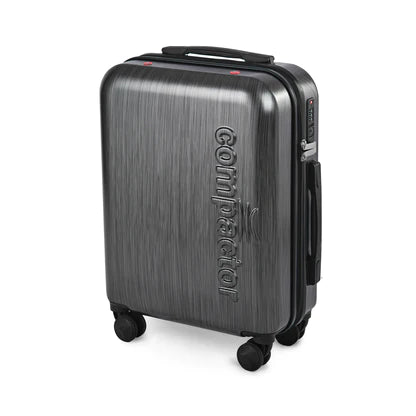
The example of the dark grey Graphite hybrid cabin suitcase from Compactor
- 50% more space than a conventional suitcase.
- Telescopic handle
- Hard case
- A complete all-in-one system - the case contains a built-in vacuum bag and comes with a hand pump to remove air as well as a free hand scale.
2-wheel vs. 4-wheel suitcases
2 Wheels (Trolley): Trolley suitcases, fitted with two wheels, are designed to be pulled behind you. They have the advantage of navigating better on rough surfaces, such as cobblestones, and the two integrated wheels take up less space in the suitcase compartment, thus maximizing internal packing space. However, they can be more difficult to maneuver in tight spaces.
4-wheel (Spinner): Spinner suitcases, with their four wheels, offer 360-degree maneuverability, allowing you to push them alongside you through narrow aisles on airplanes or airports. They are especially convenient in lines and crowded areas. While spinners are easier to maneuver, the wheels can be more vulnerable to damage and take up a bit more space, which may affect the suitcase's acceptance as carry-on luggage on some airlines.
The Compactor Cosmos Black Hybrid Suitcase with 4 wheels simplifies your travels through airports and also benefits from patented technology that incorporates an ingenious vacuum storage system directly integrated into the suitcase.

Smart cabin suitcases
Innovation never stops in the world of carry-on luggage, and smart models are proof of this. These suitcases incorporate advanced technological features, such as USB ports for charging your devices, built-in scales to avoid overweight fees, and even fingerprint locking systems for added security. Some are fitted with GPS to track your suitcase anywhere in the world via an app. While these suitcases offer the ultimate in convenience and security, they can be more expensive and require regular checks for airline regulations regarding onboard lithium-ion batteries.
How to optimize space in your cabin suitcase?
Traveling light doesn't have to mean making sacrifices. With a few tips and tricks, you can maximize the space in your carry-on suitcase, allowing you to pack everything you need without feeling weighed down. Here's how to maximize every inch of your carry-on for a hassle-free trip.
Folding and storage techniques
Vacuum storage: For larger items, consider using compression bags. By sucking out the air, these bags significantly reduce the volume of your clothes, freeing up valuable space for other necessities. Compactor technology is integrated directly into its carry-on suitcases. The Compactor range also offers smart solutions for significant space-saving.
Roll method: Instead of folding your clothes, roll them. This technique not only reduces wrinkles but also efficiently fills empty spaces in your suitcase. Rolled clothes take up less space and are easy to organize.
Using packing cubes: Packing cubes are perfect for separating your belongings and optimizing space. They allow you to group clothes by category (tops, bottoms, underwear, etc.) and make it easier to access what you need without disturbing the rest of your belongings.
Travel Essentials List
Plan ahead : Make a list of essentials based on the length of your trip and planned activities. This will help you avoid overloading your suitcase with "just in case" items you probably won't use.
Choose versatile clothing : Opt for clothing that can be mixed and matched to create multiple outfits from a limited number of pieces. Choose lightweight fabrics and neutral colors for maximum versatility.
Limiting Duplicates : Avoid packing multiple similar items. For example, a comfortable pair of shoes can often serve both a walking and casual night out.
Tips for maximizing space
Make use of hollow spaces: Use the space inside your shoes to store socks, chargers, or other small items.
Reduce toiletries: Opt for miniature versions of your toiletries or use reusable containers to carry only the necessary amount. Also consider solid products (shampoo, soap) that aren't subject to carry-on liquid restrictions. Use travel storage bags .
Electronics and Accessories: Neatly wrap cables and use dedicated organizers to avoid clutter. Choose multifunctional devices (e.g., a smartphone can serve as a camera, music player, and travel guide) to reduce the number of items you need to carry.
Maintenance and durability of your cabin suitcase
A quality carry-on suitcase is an investment that, with proper care, can faithfully accompany you on many adventures. Taking care of your carry-on luggage not only extends its lifespan but also ensures that it remains beautiful and functional trip after trip. Here are some tips to keep your carry-on suitcase in perfect condition and maximize its durability.
Care instructions
Regular Cleaning: The first step to keeping your suitcase in good condition is to clean it regularly. For soft-shell suitcases, use a damp cloth with a little mild soap to clean exterior stains. Hard-shell suitcases can be cleaned with a cleaner specifically designed for this type of material or a simple mixture of water and vinegar to remove marks and scuffs.
Wheel Maintenance: Wheels are essential to the maneuverability of your suitcase. Clean them regularly to remove debris and dirt that can build up and cause jams. A little silicone oil can help keep them moving smoothly.
Checking zippers: Zippers are often the first to show signs of wear. Ensure they work properly by opening and closing them regularly. You can apply a zipper-specific lubricant to keep them smooth and prevent jams.
Proper Storage: When not in use, store your carry-on suitcase in a dry place away from direct sunlight to prevent discoloration and damage. If possible, keep it open or slightly ajar to prevent mold or unpleasant odors.
Sustainability and eco-responsibility
Choose durable materials: When purchasing a new carry-on suitcase, opt for materials known for their durability, such as polycarbonate for hard-shell cases or ballistic nylon for soft-shell cases. These materials are more resistant to the rigors of travel and the wear and tear of time.
Repairability: Choose a suitcase that's designed to be easily repairable. Being able to replace parts like wheels, handles, or zippers can significantly extend the life of your suitcase.
Support eco-friendly brands: More and more brands are committed to sustainable and ethical luggage production. Supporting these companies not only allows you to acquire a quality product but also contributes to a more environmentally friendly industry.
By following these care tips and prioritizing sustainability when purchasing, your carry-on suitcase will remain a trusted companion for many years to come, while minimizing your environmental impact. Well-maintained luggage is the first step toward successful and conscious travel.


